Learn Geometry | 06 | Rectangle and Square
Rectangle: - A parallelogram whose sides are equal and parallelogram with all right angle is called Rectangle.
आयत :- एक ऐसा समांतर चतुर्भुज जिसकी सम्मुख भुजाएं बराबर और समांतर तथा सभी कोण समकोण हो आयत कहलाता है।

If AB || DC and AD || BC so that ABCD is a ||gm.
यदि AB || DC व AD || BC तो ABCD, एक ||gm होगा।
1★ Opposite sides of a Rectangle are parallel.
★ आयत की संम्मुख भुजाएं समांतर होती है।
AB || DC and AD || BC
2★ Opposite sides of a Rectangle are equals.
★ आयत की संम्मुख भुजाएं बराबर होती है।
AB = DC and AD = BC
3★ Opposite angles of a Rectangle are equals.
★ आयत की संम्मुख कोण बराबर होती है।
∠A = ∠C and ∠D = ∠B
4★ All angles of a Rectangle are equal and 90⁰
∠A = ∠b = ∠C = ∠D = 90⁰
★ तो आयत के सभी कोण बराबर और समकोण होते हैं।
∠A = ∠B = ∠C = ∠D = 90⁰
5★ Adjacent angles of a Rectangle are supplementary.
★ आयत की संलग्न कोण संपूरक होते हैं।
∠A + ∠B = 180⁰
∠B + ∠C = 180⁰
∠C + ∠D = 180⁰
∠A + ∠D = 180⁰
6★ The diagonals of a Rectangle are equals.
★ आयत के विकर्ण बराबर होते हैं।
AC = BD
7★ Diagonal of a Rectangle bisect each other.
★ आयत के विकर्ण एक दूसरे को समद्विभाजित करते हैं।
⭐⭐⭐⭐⭐⭐⭐⭐⭐⭐⭐⭐⭐⭐⭐⭐⭐
Deduction 1— What is the length of the other diagonal?

So ∠A = ∠D = 90⁰
Side AB = Side DC
Now
In ∆DAB = ∆ADC
AB = DC [Sides of Rectangle]
∠A = ∠D [ 90⁰ ]
AD = AD [Common Sides]
So ∆DAB ≅ ∆ADC. [by SAS congruenc Rule]
AC = BD [by CPCT] Proved
This shows that the diagonals of a rectangle always have the same in length.
⭐⭐⭐⭐⭐⭐⭐⭐⭐⭐⭐⭐⭐⭐⭐⭐⭐
Deduction 2—What is the point of intersection of the two diagonals?

SB II CD and BD is Transversal
∠ABD = ∠BDC [A. I. A.]
∠B = 90⁰
∠3 + ∠1 = 90⁰ ........ (1)
In ∆ BCD
∠3 + ∠2 + 90⁰ = 180⁰
∠3 + ∠2 = 180⁰ – 90⁰
∠3 + ∠2 = 90⁰ ........ (2)
From Equation (1) and (2)
∠3 + ∠1 = ∠3 + ∠2
∠1 = ∠2 ........ (3)
In ∆AOB = ∆COD
∠1 = ∠2 [From Equation 3]
∠AOB = ∠COD [ V.O.A. ]
AB = CD [given]
So ∆AOB ≅ ∆COD. [by AAS congruenc Rule]
AO = CO [by CPCT] Proved
BO = OD [by CPCT] Proved
So, O is the midpoint of AC and BD.
This shows that the diagonals of a rectangle always intersect at their midpoints.
When the diagonals cross at their midpoints, we say that the diagonals bisect each other. Bisecting a quantity means dividing it into two equal parts.
⭐⭐⭐⭐⭐⭐⭐⭐⭐⭐⭐⭐⭐⭐⭐⭐⭐
Deduction 3— What are the angles between the diagonals?


⭐⭐⭐⭐⭐⭐⭐⭐⭐⭐⭐⭐⭐⭐⭐⭐⭐
★★★★★ Vinjeet Vedic Maths ★★★★★
Square: - A parallelogram one of whose angles is a right angle with a pair of adjacent sides equal is called Rectangle.
वर्ग :- एक ऐसा समांतर चतुर्भुज जिसका कम से कम एक कोण समकोण तथा संगत भुजाऐं बराबर हों वर्ग कहलाता है।
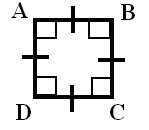
If AB || DC and AD || BC so that ABCD is a ||gm.
यदि AB || DC व AD || BC तो ABCD, एक ||gm होगा।
1★ Opposite sides of a Square are parallel.
★ वर्ग की संम्मुख भुजाएं समांतर होती है।
AB || DC and AD || BC
2★ All sides of a Square are equal.
★ वर्ग की सभी भुजाएं बराबर होती है।
AB = BC = CD = DA
3★ Opposite angles of a Square are equals.
★ वर्ग की संम्मुख कोण बराबर होती है।
∠A = ∠C and ∠D = ∠B
4★ All angles of a Square are equal and 90⁰
∠A = ∠B = ∠C = ∠D = 90⁰
★ तो वर्ग के सभी कोण बराबर और समकोण होते हैं।
∠A = ∠B = ∠C = ∠D = 90⁰
5★ Adjacent angles of a Square are supplementary.
★ वर्ग की संलग्न कोण संपूरक होते हैं।
∠A + ∠B = 180⁰
∠B + ∠C = 180⁰
∠C + ∠D = 180⁰
∠A + ∠D = 180⁰
6★ The diagonals of a Square are equals in length.
★ वर्ग के विकर्ण आपस में बराबर होते हैं।
AC = BD

7★ Diagonal of a Square bisect each other.
★ वर्ग के विकर्ण एक दूसरे को समद्विभाजित करते हैं।
8★ Diagonal bisect each other at right angle (90⁰).
★ विकर्ण एक दूसरे को समकोण पर समद्विभाजि करते हैं।


Comments
Post a Comment